








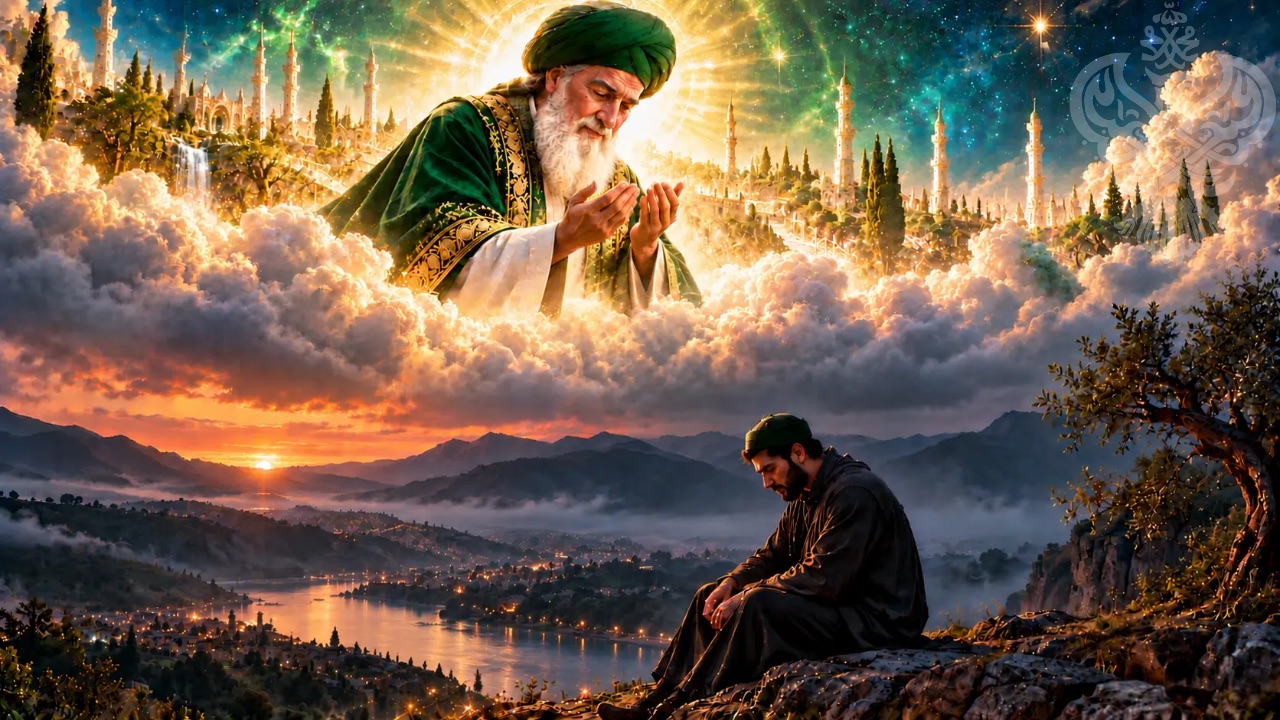
Not Feeling Spiritually Connected Anymore? Did you Forget About Your Shaykh? Q&A
From the Realities of Mawlana (Q) as taught by Shaykh Nurjan Mirahmadi
أَعُوذُ بِاللَّهِ مِنَ الشَّيْطَانِ ٱلْرَّجِيمِ
بِسْمِ ٱللَّهِ ٱلرَّحْمَٰنِ ٱلرَّحِيمِ
A’uzu Billahi Minash Shaitanir Rajeem
Bismillahir Rahmanir Raheem
I seek refuge in Allah (AJ) from the accursed Satan
In the Name of Allah, the Most Compassionate, the Most Merciful
Alhamdulillahi Rabbil ‘aalameen, was salaatu was salaamu ‘alaa Ashrafil Mursaleen, Sayyidina wa Mawlana Muhammadul Mustafa ﷺ. Madad ya Sayyidi ya Rasulul Kareem, Ya Habibul ‘Azeem, unzur halana wa ishfa’lana, ‘abidona bi madadikum wa nazarekum.
Atiullah wa atiur Rasul wa Ulil amre minkum. Always a reminder for myself, ana abdukal ‘ajeez, wa dayeef, wa miskin, wa zhalim, wa jahl, and but for the grace of Allah (AJ) that we’re still in existence.
أَطِيعُوا اللَّهَ وَأَطِيعُوا الرَّسُولَ وَأُولِي الْأَمْرِ مِنكُم… ﴿٥٩﴾ …
4:59 – “…Atiullaha wa atiur Rasula wa Ulil amre minkum…” (Surat an-Nisa)
“…Obey Allah, obey the Messenger, and those in authority among you…” (The Women, 4:59)
Question 1: In yesterday’s suhbah (discourse) you mention about Prophet Sayyidina Muhammad ﷺ thirteen years of struggle in Makkah and 10 years’ life in Madinatul Munawwara (luminous city of Prophet ﷺ). What’s the secret message behind these numbers 13 representing letters meem and 10 is a binary code of 1 and 0? Please forgive our ignorance.
 Shaykh Nurjan Mirahmadi: That mashaAllah that is nice, alhamdulillah there must be a secret in it. Keep contemplating connecting your heart and what Allah (AJ) wants you to know of it.
 But the 13 and the reality of meem, so this is the letter meem and the secret of meem is everything. So the one whom unlocks the secret of meem is the Muhammadan kingdom. That, that 13 that meem has a value of 40. That’s why roshd and maturity is at 40 years of age. So has a value of 40 and the secret of 40. So all the huroof (Arabic letters) have a reality. So for those whom are capable of understanding the huroof, they read the articles. Study them and alhamdulillah, inshaAllah Allah (AJ) grant in their hearts a greater understanding. The general audience gets confused because they’re still on the subject of ‘what is Muharram.’ So, inshaAllah we try to give it slowly, slowly.
Question 2: Why do I feel like my shaykh has forgotten me?
Shaykh Nurjan Mirahmadi: Yeah, we’re getting a lot of that and this is a reality in our lives of our own state. That which you forget, you can easily understand that, ‘They have forgotten me’ and that’s the whole concept. When we say nazar (gaze), a lot of new people don’t, ‘What is nazar mean? Why do you keep saying nazar?’ It is the gaze how to be under Divine Grace. ‘How come I feel I’m not connected to my shaykh?’ But that’s not from the side of the shaykh, that’s completely in the hands of the one whom loves the way.
 Have you forgotten your shaykh? Are you continuously thinking of that person? You know you do zakat (charity) because you’re mandated to do it. But you can send a gift out of love, you can send an email that, ‘Shaykh I’m doing well, everything is good, please pray for me.’ Why is it that we expect something but we don’t give anything in return? We just expect it. Then you can expect all you want, it is like a bus that never shows up. That’s not how the system works.
 The whole system was from Holy Companions (as). Why were they fighting in every battle? Why were they continuously surrounded by Prophet ﷺ? Continuously, they would go out to the marketplace, they would bring dates. They would do this, they would do that. Their whole life, he ﷺ was the nucleus of their existence. They found no greater desire than to continuously be in that presence. Well, you can be in that presence. It is limited physical; you can be spiritual through your connection. Through your actions, through expressing your love. You send a gift, you send a email, you give a salaams (greetings). You put nice and beautiful comments on everything that being produced.
 You make your life’s focus the shaykh. There is not a moment when you’re thinking, ‘I’m not thinking of my shaykh.’ As a result, if you live like that, then you have to know, you have to know, the shaykh is continuously thinking about you. Because everywhere he is doing, he is seeing your name pop up. You sent a gift, he sends back a reply. You made a comment, he sends back a ‘thank you.’ You send an email because your whole life is this interaction. You’re taking the step to say that, ‘My whole life’s focus is you. Please send your nazar on me.’
 The ones whom Allah (AJ) opens that relationship, then this is a great reward for them. There are people the shaykh has to contact all the time. ‘Where is this? Where is that? Where is this accounting report? Where is this image? Where is this graphics?’ This was the gift from Allah (AJ) that you wanted to be under their nazar, your service is accepted. Your ability to serve and to provide that which is valuable as an expression of your love brought you into this whole relationship. ‘Why is he emailing so much? Why is he asking for this graphic, this, this?’ Well, that was the whole interaction. This was the whole benefit of building that relationship.
 So that’s why we encourage people on how we were raised. Our whole life was our shaykh, not three shaykhs, not five shaykhs, just our one shaykh. We had to make that relationship, build that relationship, serve that relationship. With our entire life, we put at his feet, and whatever Allah (AJ) opened, opened. Because of that love and made a bond that cannot be broken and is greater than space and time and is an eternal bond. Not a bond from this earth, but something that takes us to all of eternity.
 So as much as you put into it, you feel the reward of it. But people who put nothing into it, and then they’re surprised that ‘I’m not feeling anything.’ How are you going to feel something? If you don’t tell your family you love them and you don’t express your love, they will never know you love them. That’s your family. That, you may not ever get a email and feeling something spiritual. But if you do that to the shaykh, you will have no connection, and you will have established no connection with any reality. So the shaykh is trying to teach you a system of love. If you love, serve. If you love, express it. Jum’ah (Friday prayer) comes, and you didn’t even say ‘Jum’ah Mubarak’ so then what do you expecting? A du’a (supplication) on Jum’ah from the shaykh? No. So what you put into it, what you get out of it. If your life becomes so busy that you forgot the shaykh, then know the shaykh forgot you. So this is not a way to live our lives.
 So the shaykh’s got 10,000 directions he has to look. You want to make sure that you’re always in his face. That’s the life of getting their nazar. Do good deeds, good actions, ‘I went out and gave this food. I went and I sent this. I went and I did this, and here is this and here is this email.’ Alhamdulillah, they lived that life. But not everybody is going to do that because not everybody wants that level. But those who want it because they’re asking it, they email about it.
 This is a system. Put into it and you’ll never be disappointed. This is Allah’s (AJ) promise that anything you put in Allah’s (AJ) way, what does Allah (AJ) mean that it won’t be wasted? Says, ‘Not a mustard seed is not accounted for.’
وَنَضَعُ الْمَوَازِينَ الْقِسْطَ لِيَوْمِ الْقِيَامَةِ فَلَا تُظْلَمُ نَفْسٌ شَيْئًا ۖ وَإِن كَانَ مِثْقَالَ حَبَّةٍ مِّنْ خَرْدَلٍ أَتَيْنَا بِهَا ۗ وَكَفَىٰ بِنَا حَاسِبِينَ ﴿٤٧﴾
21:47 – “Wa nada’ul mawazeenal qista li Yawmil Qiyaamati, falaa tuzlamu nafsun shai’aa; wa in kaana misqaala habbatim min khardalin atainaa bihaa; wa kafaa binaa haasibeen.” (Surat Al-Anbiya)
“And We place the scales of justice for the Day of Resurrection, so that no soul will be treated unjustly at all. And if there is [even] the weight of a mustard seed, We will bring it forth (to account). And sufficient are We as accountant.” (The Prophets,
Nothing that you do in Allah’s (AJ) way is going to be wasted. This is a very specific way of Allah (AJ) that when you come into the world of these shaykhs, this is a Muhammadan haqqaiq. When you make that reality to be your entire focus, then you feel its immensity and its blessings in everything that you do, inshaAllah.
Question 3: Is the struggle in the way of Allah (AJ) with our wealth and lives mandatory for everyone as it is mentioned in Surah Tawbah?
Shaykh Nurjan Mirahmadi: Yeah, read that we were talking earlier, shaykh. Read the verse, Hajji Shahid. What’s the verse number, Zeeshan, from Surah Tawbah? [Shaykh asks audience]. Again, everybody to read Surah Tawbah because this is the gate of this month [Muharram]. So everybody should be studying it and understanding it. The first 20-30 verses, I think, are all about mushrikeen (polytheists).
 So say, ‘Shaykh, what is all this mushrik, mushrik, mushrik?’ Mushrik is to make a partner with Allah (AJ). Straight out mushrik – when you make a statue and you worship that statue as a means to drawing closer to the Divine. It is horrific and completely forbidden. These people are now making humans to be mushrik. They say, ‘This human, he is god, therefore come to us.’ So relevant to this gate this year, the religions whom we thought were monotheistic, they’re now showing themself to be mushrikeen. They are not similar; we are not similar. We have nothing to do with any man who calls himself god. Then the cousin says, no, their messiah, he is a messiah. Yeah, but in your doctrine he is going to call himself Hashem, which is their name for God. That is a mushrik.
 So say, ‘Oh shaykh, we’re similar.’ Absolutely not similar. Because now the mushriks have shown themself. What the nation of Islam, under the order of Prophet ﷺ, ‘What I fear most for my nation is they’re not going to make Muhammadun Rasulullah ﷺ to be god, astaghfirullah.’ He said, ‘I fear for my nation hidden shirk, shirk e khafi,’ which was what? The Ahlul Bid’ah (people of innovation) people. Hidden shirk is when somebody sits and pretends they’re god and they start to pass judgment on everyone. Because that was the greatest shirk. The hidden shirk is the one who sits and judges God’s creation.
 They have like little chairs and they start saying, ‘No, no, you’re in jahannam (hellfire), you’re like this, you’re like that, you’re like this. Allah (AJ) says, ‘You don’t know anything about yourself. How would you know the ‘amal (action) of that servant? How could you pass judgment on a servant when you can’t pass judgment even on yourself?’ So,
-
- Other nations, they’re waiting for their Prophets (as) and turn them into gods.
- Or the other one outright, he thinks the cow is a god.
- But for the nation under Sayyidina Muhammad ﷺ, this first verses of Surah Tawbah are about the people whom are making and passing judgment. Acting as if they are little ilaha.
 That’s, you see them with their that cloth and they sit and they say: ‘Everything haram (forbidden), you’re haram, you’re haram. You’re going to hell, you’re going to hell.’ How you know who is going to hell? You only have to worry about if you yourself are going into hell. So this is the sickness that Prophet ﷺ described for his nation. Now for Surah Tawbah what is the verse we’re going to recite Surah Tawbah 9 verse?
Audience: Na’am Sayyidi.
Yeah, 9:44. What we got shaykh?
Reciter: “A’uzu Billahi minash shaitanir Rajeem. Bismillahir Rahmanir Raheem. Laa yastaazinukal lazeena yu’minoona billaahi wal Yawmil Aakhiri ai yujaa hidoo bi amwaalihim wa anfusihim; wallaahu ‘aleemum bilmut taqeen.”
(٤٤) لَا يَسْتَأْذِنُكَ الَّذِينَ يُؤْمِنُونَ بِاللَّهِ وَالْيَوْمِ الْآخِرِ أَن يُجَاهِدُوا بِأَمْوَالِهِمْ وَأَنفُسِهِمْ ۗ وَاللَّهُ عَلِيمٌ بِالْمُتَّقِين
9:44 – “Laa yastaazinukal lazeena yu’minoona billaahi wal Yawmil Aakhiri ai yujaa hidoo bi amwaalihim wa anfusihim; wallaahu ‘aleemum bilmut taqeen”. (Surat At-Tawbah)
“Those who believe in Allah and the Last Day would not ask permission of you to be excused from striving with their wealth and their lives. And Allah is Knowing of those who fear Him.” (The Repentance, 9:44)
Shaykh Nurjan Mirahmadi: Junaid, what do we got for English shaykh?
Reciter: ‘And those who believe in Allah (AJ) and the last day will not seek exemption from you for not fighting with their wealth and their lives and Allah (AJ) well knows the pious.‘
Shaykh Nurjan Mirahmadi: The next verse.
Reciter: “Innamaa yastaazinukal lazeena laa yu’minoona billaahi wal Yawmil Aakhiri wartaabat quloobuhum fahum fee raibihim yataraddadoon.”
إِنَّمَا يَسْتَأْذِنُكَ الَّذِينَ لَا يُؤْمِنُونَ بِاللَّهِ وَالْيَوْمِ الْآخِرِ وَارْتَابَتْ قُلُوبُهُمْ فَهُمْ فِي رَيْبِهِمْ يَتَرَدَّدُونَ ﴿٤٥﴾
9:45 – “Innamaa yastaazinukal lazeena laa yu’minoona billaahi wal Yawmil Aakhiri wartaabat quloobuhum fahum fee raibihim yataraddadoon”. (Surat At-Tawbah)
“Only those would ask permission of you who do not believe in Allah and the Last Day and whose hearts have doubted, and they, in their doubt, are hesitating.” (The Repentance, 9:45)
Reciter: ‘Only those ask for such an exemption from you who do not believe in Allah (AJ) and the last day and whose hearts are in doubt so they waver in their doubts.’
 Muttaqeen (those with high level of consciousness), so it means there is no way other than this gate. So whatever the shaykhs are teaching of struggle, struggle, you must struggle in the way of Allah (AJ). There is not a people that say, ‘Oh can I have an exemption? I don’t want this right now.’ Allah (AJ) say, ‘You would never ask that.’ If you’re with Sayyidina Muhammad ﷺ you will not ask for an exemption from struggling in life and trying to purify yourself and have good character, ‘Oh shaykh I’ll pass this year, maybe next year I’ll be better.’
 No, no this year maybe your only year. If you love and you want to reach to Prophet ﷺ, we are not the people to ask for exemptions. You become muttaqeen and this was from what we talked at the beginning of Holy Qur’an. That the muttaqeen means they have the certainty through all their senses – these are not the stations of regular people. The tariqahs (spiritual paths) produce the muttaqeen in which their eyes have yaqeen (certainty). Their ears have yaqeen, their breath has yaqeen, their sense of feelings have yaqeen. What does Holy Qur’an say at the beginning? What is the first verse after Surah Fatiha of Surah Baqarah is opening up, “Alif, Laam, Meem, Dhaalikal kitaabu laa rayba feeh, fa hudal lil muttaqeen.”
(٢) الم ﴿١﴾ ذَٰلِكَ الْكِتَابُ لَا رَيْبَ فِيهِ هُدًى لِّلْمُتَّقِينَ
2:1-2 – “Alif, Laam, Meem. (1) Zaalikal kitaabu laa rayba feeh, hudal lil muttaqeen. (2)” (Surat Al-Baqarah)
“Alif, Lam, Meem. This is the Book that there is no doubt/crookedness in it, it’s a guidance for pious people who are conscious of Allah.” (The Cow, 2:1-2)
 So, means what? The Qur’an has to be uncoded and it is only “hudal lil muttaqeen.” It is not a hudan (guidance) for anyone else. This level of reality is a “hudal lil muttaqeen,” is a guidance for the muttaqeen. So, our life was to become muttaqeen. So, means people whom reading Qur’an alhamdulillah is barakah, blessing, guidance. But muttaqeen where all their five senses Allah (AJ) gave them a yaqeen and certainty on all five senses? No. At least they have to know what alif, laam, meem is.
 So, means these are all the encryptions and the codes of Holy Qur’an. So, this is what Allah (AJ) is giving to us is this Baab at-Tawbah (door of repentance), there is no “Bismillahir Rahmanir Raheem.” Because “Bismillahir Rahmanir Raheem” means, ‘Oh in the name of God Most Compassionate, Most Merciful I’m not going to sacrifice myself this year.’ But no, tawbah (repentance) – no has “Bismillahir Rahmanir Raheem.”
 So, means “Bismillah Allahu Akbar” that we enter into the gate of tawbah. That Allah (AJ), our neck is on the table, ‘Ya Rabbi make me to be halal (permissible) for Sayyidina Muhammad ﷺ, to be halal for Imam Mahdi (as).’ That, take away my bad character and our way is very beatific way. It is not based on nafsani (egocentric) and hardship. Make Durood Sharif (praising on Prophet Muhammad ﷺ), do good deeds, good actions, show and express your love to people, to the shaykh. All of these acts are very kind and gentle and loving, you don’t need to be smashed and disintegrated.
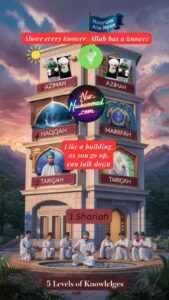 So, the way that the shaykh is teaching it is a very beatific way based on love and good character. Continuous actions towards showing the Divinely Presence, our love. Every time we’re coming short, we’re doing good and charitable deeds that, ‘Forgive me, forgive me.’ So this is a whole system and if we work it, it works beatifically. Anywhere we look it is verified in Qur’an, this is not something we make up. This is not the things that awliyaullah (saints) made this up. This is the guidance of Holy Qur’an, the sunnah (traditions) of Sayyidina Muhammad ﷺ. But these are at the levels of tariqah, ma’rifah (Gnosticism), haqqiqah (reality) and ‘Azimah (determination). ‘Azimah being the highest means they have a zeal, a himmah that can move a mountain, move a planet.
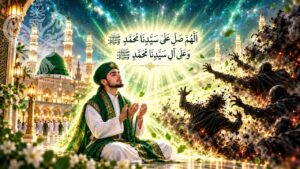 So, this not something easy to have that level of himmah (zeal). People say, ‘Shaykh I’m tired, I’m like this.’ Oh of course you are, you’re not moving yourself, how are you going to move a mountain? So, just lifting yourself seems to be a big deal. Keep making your salawat (praises upon Prophet Muhammad ﷺ), keep making your Durood, keep making your practices.
 Every time it becomes harder, there must be a secret in there that you have to struggle. It is like a marathon, if you stop, you’re not going to get to the finish line. At that point in which you feel exhausted and tired is the time that you have to push through it. Give some charity, do your salawats, do some khidmat (service) and share some articles and you push through it. Alhamdulillah each time you become stronger and can endure more.
 InshaAllah, Allah (AJ) give us these lights, these blessings and these understandings. InshaAllah more and more people to read Surat At-Tawbah to understand this gate of forgiveness. Every ‘aha’ moment that so much of ayatul kareem (the generous verse of Holy Qur’an) from Surah 9, Surah Tawbah is all Naqshbandiya realities. Because this is the gate in which they’re moving through, this is the gate and entrance of forgiveness.
Subhana rabbika rabbal ‘izzati ‘amma yasifoon, wa salaamun ‘alal mursaleen, walhamdulillahi rabbil ‘aalameen. Bi hurmati Muhammad al-Mustafa ﷺ wa bi siri Surat al-Fatiha.
Special thanks to our transcribers for their help with transcribing this suhbah.
Original Date of Suhbah: July 12, 2024
Related Articles:
- Get Off Your Couch, Build Your Himmah and Be of Service!
- Realities of Bab e Tawbah (Door of Repentance) 9
- “Alif Laam Meem – Huda lil Muttaqeen” (2:1-2) Who are Muttaqeen?
- Skin Color & Divine Favor
- Don’t Let Your Inner Munafiq Overtake You!
- How to Know Your Closeness to Allah (AJ), Sayyidina Muhammad ﷺ and to Your Shaykh
- Secrets Revealed by Huroof (Arabic Letters): ‘Meem’ of Muhammadun Rasulallah ﷺ is The Key to Every Power Q&A
Please Donate and support us to spread these heavenly knowledges by clicking the heart button below.

Copyright © 2026 Naqshbandi Islamic Center of Vancouver, All Rights Reserved.